The software to sell energy under your own brand
CRM, AI comparator, SIPS, power optimisation, WhatsApp and a voice agent: everything good energy software has. The difference is the model. We operate as white label: you don't sell someone else's tariffs, you sell your brand, and every contract leaves you a recurring margin for as long as it stays active.
Energy software, with a different model
Almost all software for selling energy stops at the tool: it helps you build the comparison and the proposal, and the contract ends up under someone else's brand. You get a commission, if they pay it, and the portfolio is not yours.
LeadEnergIA is software, and good software: it reads bills with AI, queries SIPS, Spain's supply point register, optimises contracted power and follows every sign-up until the contract is active. But it runs on the white-label model: the product comes with the tool. You sell electricity under your own brand, at some of the lowest prices on the market, and keep a recurring margin on your portfolio. No supply licence, no guarantees and no market risk.
Why white label beats any other software
You sell your brand, not someone else's
The proposal, the client portal and the emails carry your brand. The client remembers you, and when they renew, they renew with you.
Recurring margin, not a one-off commission
Every contract leaves you a margin for as long as it stays active, and renewals pay you too. With ordinary software you get paid once per contract, and whatever happens next is no longer your business.
No per-user licences
The software is part of the model. You add your whole team, reps and partners, without the fee growing with every person.
From bill to active contract, in one place
With a generic CRM the offer is made in one place, the sign-up in another and the follow-up on WhatsApp. Here comparator, proposal, sign-up and portfolio sit together, because the tool and the product are the same thing.
Prices to win, and you set the margin
Some of the lowest tariffs on the market, fixed and indexed, and you decide the margin you publish them with. You can beat another advisor on price without giving away what is yours.
No licence, no guarantees, no risk
You don't have to set up a utility or lodge guarantees with the market. You sell; the regulatory side is built into the model.
| Partner platform | Generic CRM or software | LeadEnergIA | |
|---|---|---|---|
| Whose brand do you sell? | The platform's or the supplier's | The supplier you have a deal with | Yours |
| How do you earn? | A per-contract commission set by the platform | The commission the supplier pays you | Recurring margin on your portfolio, renewals included |
| What do you pay for the tool? | Nothing: it is taken from your contracts | A licence, usually per user | No per-user licences |
| Who sets the client's price? | The platform | The supplier | You set the margin |
| AI bill reading and SIPS | Depends on the platform | Usually not | Yes |
| Power optimisation | Depends on the platform | Usually not | Yes, from real maximum demand |
| From yes to active contract | Depends on the platform | By hand, outside the CRM | Client portal, checklist and rejection reasons |
| WhatsApp and AI voice agent | Depends on the platform | Separate tools | Yes, inside the opportunity |
| Team and commissions | Built for the individual rep | Depends on the CRM | Roles, reps and commissions per concept |
If you are comparing tools, our guide how to choose a tool to sell energy (in Spanish) lists the nine things it must do and the questions to ask before signing. And the model in depth is in the white-label energy guide.
Who it is for (and who it isn't)
For companies with clients or a sales network that want to sell energy under their own brand:
- Energy advisory firms and consultancies that run studies for SMEs and businesses and want the savings they find to stay in their portfolio.
- Brokers and insurers that already own the client relationship and want one more recurring product.
- Engineering firms and solar installers that sell the electricity alongside the installation.
- Property managers, telecoms and service companies with thousands of clients who already pay an electricity bill.
- Sales networks with several reps and a manager who needs to see what is happening without chasing anyone.
It is not for those looking only for a tool to sell the tariffs of the suppliers they already work with. Here the tool comes with the product, and the product carries your brand.
What it does, from bill to proposal
Reads the bill with AI, as a PDF or a photo
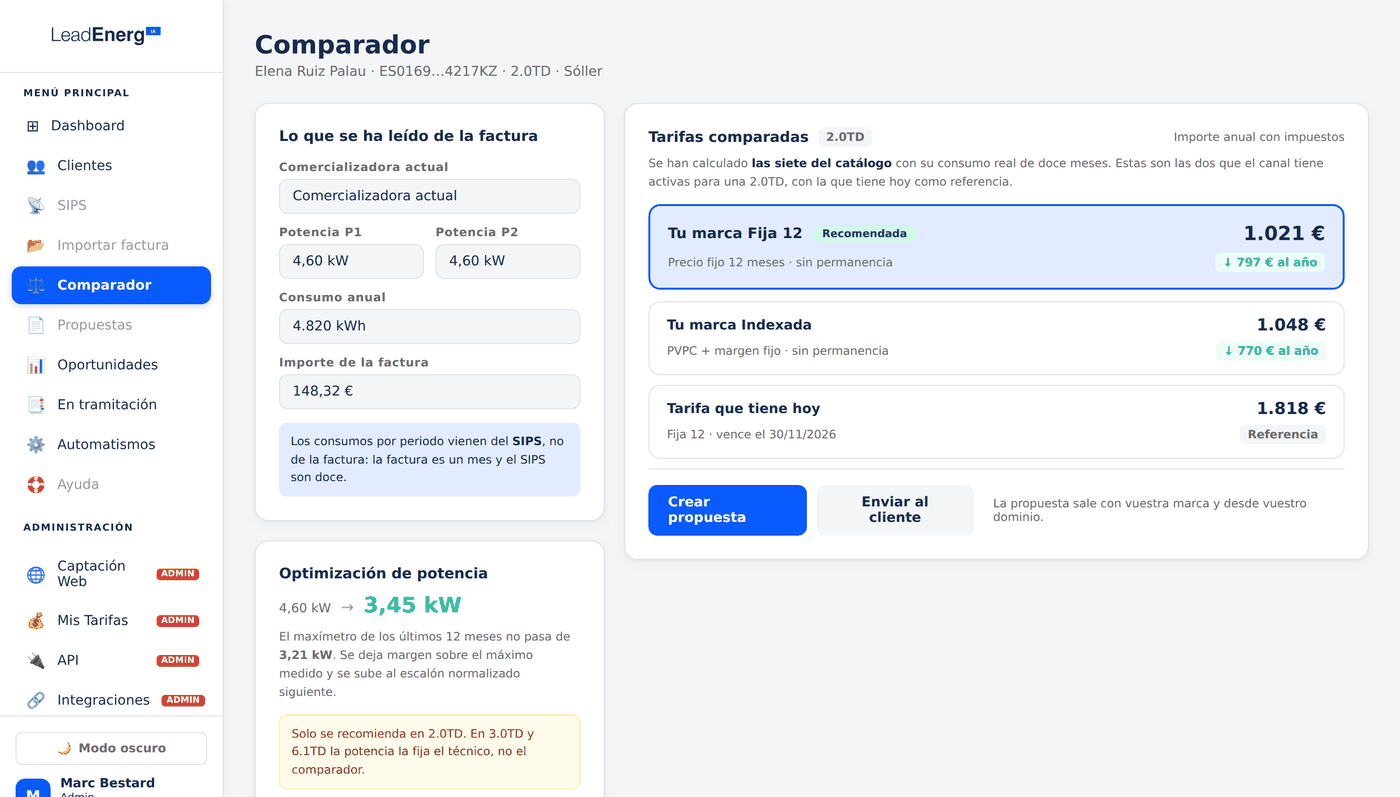
The rep uploads the bill and the platform extracts the CUPS, holder, tax ID, access tariff, power per period, consumption and amount. Everything is editable and the comparison recalculates instantly. Nobody types a 22-character CUPS in the middle of a visit.
Real consumption from SIPS, not estimates
With the CUPS, the platform queries SIPS, Spain's supply point register: twelve months of consumption per period and the maximum demand readings. The bill shows one month; SIPS shows the whole year, which is what an offer should be calculated on.
Power optimisation from real maximum demand
Using the last twelve months of maximum demand, it proposes the power the supply really needs. On many bills that is a share of the saving no tariff change achieves on its own, and it is the hardest argument to dispute: it comes from the client's own data.
A comparator with your catalogue
The comparator runs the tariffs in your catalogue, fixed or indexed, for homes and businesses, against the client's real consumption. You decide which tariffs are published and with what margin; each rep sees what concerns them, never your margin.
Indexed tariffs explained month by month
If you offer an indexed tariff, the proposal shows the last twelve months of market prices by period, the average and the saving against what the client pays today, so they understand how it works before signing. It is the report that makes the difference when the client has another offer on the table.
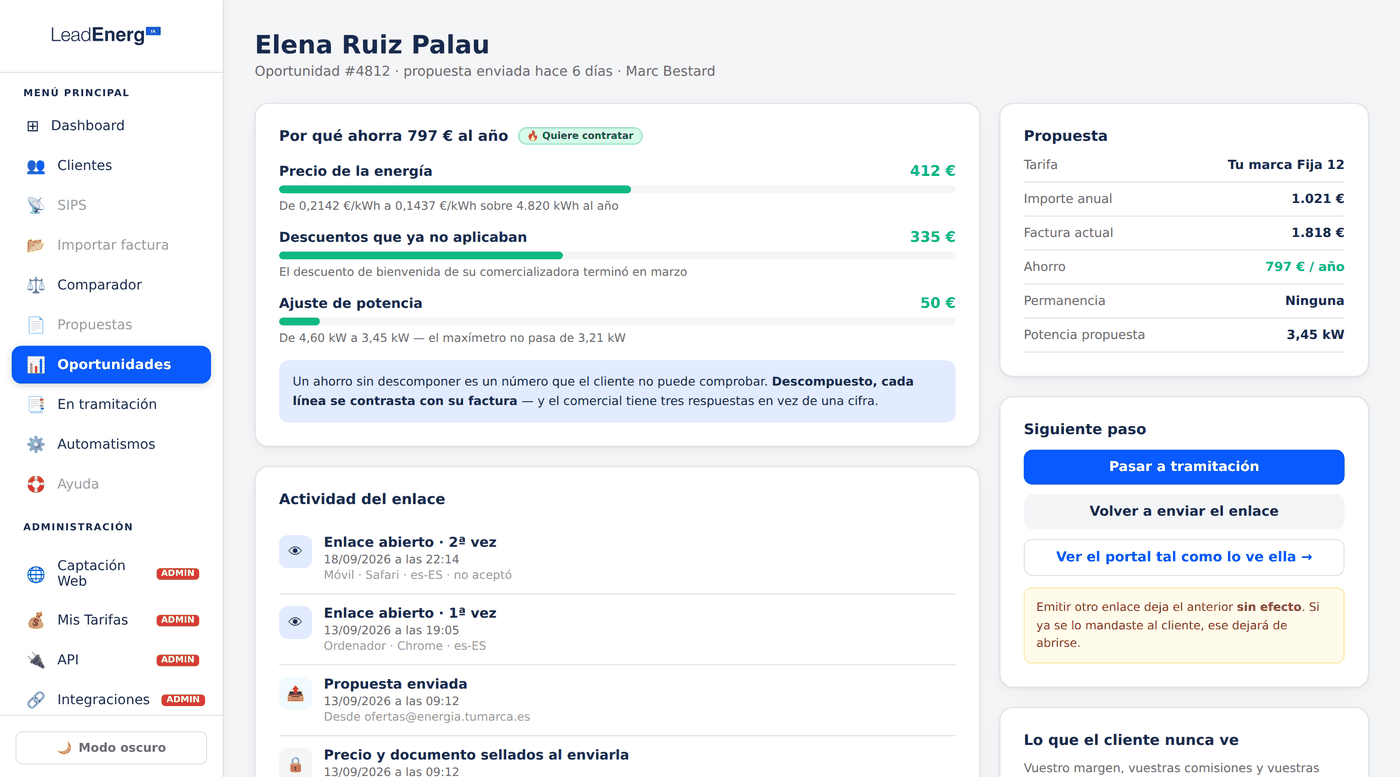
A proposal with your logo and the saving broken down
The proposal goes out under your brand and explains the saving line by line: energy price, power and discounts that no longer applied. The price is sealed when it is sent, and you can see when the client opens it and on which device.
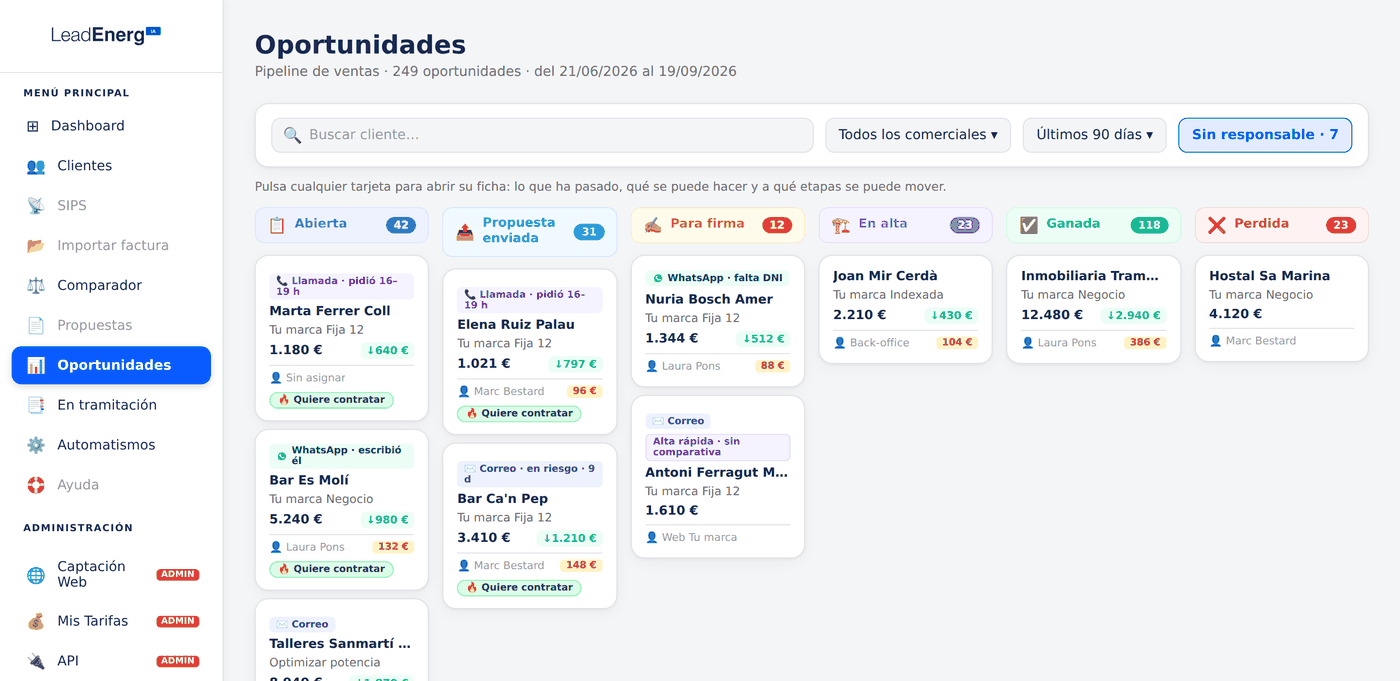
A pipeline that says whose move it is
Few stages, each with an owner: open, proposal sent, ready to sign, switching, won, or lost with its reason. Whoever runs the team sees where each opportunity stalls and why deals are lost, without asking anyone for a report.
Your own lead capture
Each rep has a personal link and QR code for their card, email signature or WhatsApp, and you get a comparator to embed on your website. Leads come in with their source and the client's consent recorded.
From yes to an active contract
The sale does not end when the client says yes. It ends when the contract is active, and in between is where most contracts are lost.
A client portal to complete the sign-up
When the client says they want to sign up, they get a link to complete their details and upload what is missing —ID, IBAN, company tax ID or deeds for businesses— from their phone. The rep does not chase paperwork on WhatsApp: they see what is missing and what has been validated.
Checklist and rejection reasons
When the file is complete, it notifies whoever processes the sign-ups. If the sign-up comes back rejected, the rejection is recorded with a standard reason, and the reason decides whose move it is: if something is missing from the client, their link reopens with only that inside.
Sign-ups with a future date
If the client is still under contract with their current supplier, you schedule the switch for the day it ends. The opportunity is not lost by waiting.
Renewals you can see coming
Contracts do not expire: they roll over. The portfolio shows which renew on their own, which have the notice window open and which are about to roll over at a worse price, and if you switch it on, the client receives an improved offer before the date.
WhatsApp, AI voice agent and your channels
WhatsApp comparator
The client sends a photo or the PDF of their bill to your brand's WhatsApp and gets the offer with the saving in the same conversation, with a link to see it in full and say they want to sign up. The opportunity is created automatically, with its source and consent recorded, and the conversation stays in the file, as do those from Instagram and Facebook Messenger. How it works.
AI voice agent
It calls people who asked to be called and answers whoever calls your number. It explains the offer in the client's language, checking the opportunity as it speaks, says it is an AI in the first sentence, hands over to a person as soon as asked and leaves the call recorded and transcribed. What it does and what it never does.
Your email, your line and your CRM
Emails go out from your domain. The SMS with the link and the forward to the rep go through your number, with Twilio or your own SIP line. And if your team lives in HubSpot, Salesforce or Pipedrive, the opportunity is mirrored there so nobody has two places to look.
API and webhooks
Your website or your system can create leads, request comparisons and hear about every status change through signed webhooks. All documented on the API page.
All on your own account and under your brand. And none of these pieces sees your margin, the commissions or the client's IBAN.
Your team, your commissions, your data
You add your team with their roles: admin, reps, back office and people who only bring you clients through their link. Each rep sees their own opportunities and commission; the manager sees everything.
Your team logs in through its own access page, with your logo and colours.
Commissions are set per rep and per concept —energy, power and web leads— and the one on each proposal is sealed when it is sent, so nobody argues later about what was promised.
And your clients' data is yours: you are the data controller and the platform processes it on your behalf, as processor. No other company using LeadEnergIA sees anything of yours.
Spain's RD 88/2026, handled inside the tool
Since June, calling an individual in Spain to sell them electricity without a prior request is prohibited, and the burden of proof is on the seller. The tool keeps what you will be asked for if anyone complains: when and from where the client asked to be contacted, every time the proposal was sent, when they opened it and when they said they wanted to sign up. The evidence lives in the opportunity, not on a rep's phone.
We cover it in detail in our article on RD 88/2026 (in Spanish).
How you get started
A demo with your bills. Bring two or three real bills and we see live what comes out with your brand and your margin.
We set up your brand. Logo, colours, your own login page and the catalogue with your margin.
You add your team. Roles, commissions and each rep's capture link.
You connect what you already use, if you want. Your email, WhatsApp, your CRM or your website via API, in the same set-up.
How you pay
No per-user licences. You can start with no fee, operating through our supplier: we only take a small percentage of what you earn. If you want your full brand, with your own domain and panel, the white label is quoted to measure, according to your integrations and requirements. We show you the numbers in the demo, with your portfolio in front of you. Both plans are under pricing.
FAQ
What is white-label energy software?
Software you use to sell energy under your own brand. Unlike a CRM or a comparator, it doesn't stop at the tool: it includes the product —the tariffs you sell under your brand— and the recurring margin on every contract, without you having to become a utility.
Do I need a supply licence?
No. You sell under your brand with no licence, no guarantees and no market risk: the regulatory side is built into the model.
How is it different from an energy CRM?
A CRM helps you sell someone else's tariffs and collect their commission. Here you sell your brand and keep a recurring margin on every contract, renewals included. And the software, from comparator to sign-up, is part of it.
How much does it cost?
No per-user licences. You can start with no fee through our supplier, and we only take a small percentage of what you earn; the full white label, with your domain and panel, is quoted to measure. We show you in the demo with your numbers.
Can my clients ask for an offer on WhatsApp?
Yes. They send a photo or the PDF of their bill to your brand's WhatsApp and get the offer with the saving in the same conversation. The opportunity is created automatically, with its source and consent recorded.
Can the voice agent call my portfolio?
No. Spain's RD 88/2026 prohibits calling to offer supply without an explicit request, so the agent only calls people who asked and answers those who call. No recorded consent, no call.
Can my whole team have access?
Yes, each person with their role: admin, reps, back office or partners who only bring clients through their link. Each sees what concerns them.
Is my clients' data mine?
Yes. You are the data controller and the platform processes it on your behalf, as processor. No other company using LeadEnergIA has access to it.
Does it work for businesses or only for homes?
Both: domestic and small-business supplies on 2.0TD and business supplies on 3.0TD and 6.1TD, with fixed and indexed tariffs.
Is there an API?
Yes: a REST API and signed webhooks to connect your website, your CRM or your management system. Details on the API page.